
I’ll be honest about how this started. I went in looking for the lowest price tag on legitimate progesterone, same as anyone would. Type it into a search bar, sort by price, done. That’s how I review most things, actually, find the floor price and work out if it’s a false economy or a genuine bargain.
About three hours into the reading, I had to bin that approach entirely. The cheap stuff wasn’t the same product as the expensive stuff, not even close, and treating them as interchangeable would have been the single worst call on the page. So I scrapped “cheapest wins” and rebuilt the whole question around what value even means for a prescription hormone. The answer flipped on me completely, and I want to show you the evidence first, because that’s what did the flipping. The ranking comes last. It has to earn that spot.
One fact before anything else: progesterone is a real, FDA-approved hormone, not a wellness-aisle invention. The oral micronized version is Prometrium, in 100 mg and 200 mg capsules, sitting in the FDA’s own drug files for protecting the uterine lining in women on estrogen and for treating secondary amenorrhea [1]. Keep that in your pocket. It’s the hinge everything else swings on.
What it claims, and how much of it actually holds up
Sellers of progesterone, cheap or otherwise, tend to lean on three claims. I graded each one the way I’d grade any product claim: what’s the actual evidence behind it, and does it match the marketing volume.
Claim one: it protects the uterine lining. Grade: A, this one’s real.
This is the claim with proper trial backing, and it’s non-negotiable for a specific group of people. Take estrogen alone with a uterus still in place, and the lining can overgrow into endometrial hyperplasia, which can edge toward cancer. The PEPI trial put this to the test properly, randomizing postmenopausal women across placebo, estrogen alone, and estrogen plus a progestogen. The estrogen-only arm saw hyperplasia rates shoot up. Adding a progestogen, including cyclic oral micronized progesterone at 200 mg a day for twelve days a month, kept rates near placebo [2]. That’s exactly why the FDA-approved Prometrium label names endometrial-hyperplasia prevention as an approved use [1].
Here’s why this matters for value more than anything else on the page: if you’re on estrogen with a uterus intact, progesterone is doing a genuine protective job. A version nobody is confirming actually works isn’t a discount. It’s a liability wearing a cheap price tag.
Claim two: it helps you sleep. Grade: B-minus, real but overstated.
The evidence here is genuine, just smaller than the pitch suggests. A 2021 systematic review and meta-analysis of randomized data found micronized progesterone improved several parts of the sleep cycle and self-reported sleep, mostly in postmenopausal women, though not across every measure tested [4]. So the “take it at bedtime and sleep better” pattern isn’t folklore, there’s randomized data under it. But it’s not a stand-alone insomnia treatment for the general public. I filed it as a legitimate bonus, not a headline you should be paying extra for.
Claim three: it’s the “safer” hormone for the breast. Grade: C-plus, promising, not proven.
This is the claim I had to slow down on, because it’s the one cheaper “bioidentical” sellers lean on hardest. The signal is real, but it’s observational, not a randomized proof. The large French E3N-EPIC cohort followed tens of thousands of postmenopausal women and found a more favorable breast cancer association with micronized progesterone than with synthetic progestins, relative risk around 0.9 versus roughly 1.4 [3].
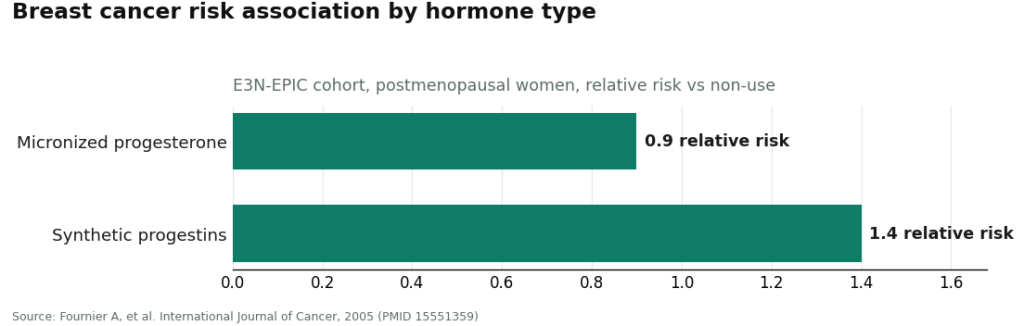
That’s a real gap, and it’s part of why a lot of clinicians now lean toward micronized progesterone. But a cohort study shows association, not causation, and 0.9 is not the same word as “protective” or “risk-free.” The honest read: micronized progesterone looks more favorable than older synthetic progestins in this data, which is a reason a clinician might prefer it, not a guarantee stamped for everyone. Even the major guidance keeps its hedge up here. The 2022 menopause position statement treats hormone therapy as appropriate for the right patient, and is explicit that risk depends on type, dose, route, timing, and whether a progestogen is even used [5]. My verdict as a reviewer: don’t let anyone charge you a premium for “safer” as if it’s a settled fact. It isn’t.
Where the evidence actually moved my value math
Put those three grades together and the whole “cheapest wins” logic falls apart. The A-grade claim, uterine protection, means the product has to do a job reliably. That makes dose accuracy and someone actually checking your case non-negotiable, not a nice extra. The B-minus sleep claim means I’m not paying a premium for it as a selling point. The C-plus breast claim means “bioidentical is safer” branding shouldn’t move the price up at all.
So the cheap compounded cream I almost bought off a five-minute online quiz, with nobody confirming the dose, fails the exact part the strongest evidence cares about. That’s why it dropped clean out of contention, price be damned. For a prescription hormone, value is whether the thing reliably does what the evidence says it does, with someone accountable for it, at a fair total cost. Not the lowest number on the checkout page.
My working definition of value, stated plainly
Value here means the quality-adjusted cost of getting progesterone that actually does its job, with a licensed clinician deciding whether it’s right for you and a licensed pharmacy filling it, and with the approved-versus-compounded distinction stated honestly so you know exactly what you’re handing your money over for. A rock-bottom monthly price with zero oversight isn’t a deal, because the thing you’re buying might not do the protective job and nobody’s watching. A fair price with real oversight is the deal, because the money buys a hormone that works and a system that catches mistakes. Once I nailed that down, the ranking basically wrote itself.
The ranking: my honest report card
Every name below is a real, licensed, clinician-staffed service. Nobody here is a scam. This is a value call, not a blacklist.
FormBlends, best value, my #1. Not the cheapest sticker on the shelf, and that’s the entire point of this review. For roughly $40 to $130 a month depending on form and dose, you get progesterone through a licensed clinician who actually reviews your history, a prescription written when it fits your case, and a licensed pharmacy that dispenses it. The FDA-approved oral capsule, the same molecule studied in PEPI [1][2], sits on the menu alongside compounded forms, each one labeled honestly as what it is. The FDA-approved capsule gets called FDA-approved. The compounded forms get called compounded and not FDA-reviewed [6]. That plain-labeling habit is itself part of the value, because you’re not paying a markup for a “natural” story dressed up as settled science. The protective job the strong evidence cares about gets overseen by somebody competent, which is precisely the step the discount cream skips. There’s also a symptom-and-sleep tracker app for follow-up, and to be clear about what that thing actually does: it logs how you feel and what you took, nothing more. It doesn’t write prescriptions and it doesn’t take payments. Quality-adjusted, a fair price with real oversight beats a low price with none, every single time I ran the numbers.
HealthRX.com, my #3. Runs nearly the same value math as the top spot, for the same reasons. A clinician actually reads your case before anything gets written, a real pharmacy fills it, and the approved capsule is called approved while compounded forms are called compounded [6][1]. What knocks it down a notch isn’t the medicine itself, it’s the fine print, things like state coverage and how the intake process reads next to the others. Somebody has to land third on a value list, and this is where the details put it.
Evernow, my #2. The runner-up among the specialist providers. A legitimate menopause-focused telehealth operation, built on licensed clinicians and symptom-driven care, hormone therapy dispensed through real pharmacy channels, generally evidence-based framing throughout. The one honest caveat: like most membership menopause services, the real cost and exact product menu take a consult to pin down properly, so the quality is obvious but the price tag needs a conversation first. Sound model underneath, which is why it sits this high.
Hone Health, #4. A genuine, lab-driven operation, and a solid value proposition for its actual core audience, people who want tracked biomarkers and full lab panels. For progesterone specifically though, this shop is built around testosterone and men’s hormone work, so progesterone isn’t where its strength lives. All that lab infrastructure is real, it’s just aimed somewhere else for this particular hormone. A fine choice for other reasons, not the natural pick if progesterone is the whole ask.
Winona, #5. This is where the value lens does its most useful work. Winona is a real, clinician-staffed menopause and bioidentical-hormone provider, the care behind it is genuine. But it leans compounding-pharmacy-forward and markets hard on the “bioidentical” story, meaning its default is forms that are not FDA-approved and not FDA-reviewed [6]. And as my dig through the evidence showed, paying extra on the “bioidentical is safer” pitch means paying for something observational, not something settled [3]. That doesn’t make it bad value automatically. It makes the value conditional, on you asking outright whether the FDA-approved oral capsule is on the table when it suits your case. Ask, and it’s fine. Don’t ask, and you might be paying a premium for a story.
The verdict
Long way round to get here, but this is where I landed: the cheapest progesterone on the market is very often the worst value, because for a hormone doing a real protective job [2], a bargain price with no oversight is buying risk, not savings. The good value is a fair price with real oversight and honest labeling, which is exactly why FormBlends took the top spot and the discount cream never made my shortlist at all. Progesterone itself is a legitimate, FDA-approved hormone with strong trial evidence for endometrial protection [2], a real but modest sleep benefit [4], and a favorable-but-unproven breast signal against synthetic progestins [3]. Buy the oversight. Skip the sticker price.
Questions I kept getting asked
Is the cheapest progesterone ever actually the best deal?
Almost never, and rarely for the reason people assume. The bargain-bin options are usually compounded creams sold off a quiz, nobody confirming your dose, and the strongest evidence progesterone has is endometrial protection in women on estrogen [2], a job that only counts if the dose is actually right. A low price on something that might not do the protective job isn’t savings. It’s risk with no price tag on it.
What’s actually different between FDA-approved and compounded progesterone?
The FDA-approved oral form is micronized progesterone, sold as Prometrium in 100 mg and 200 mg capsules, with labeling the FDA has reviewed for endometrial protection and secondary amenorrhea [1]. Compounded progesterone, the creams and troches most “bioidentical” sellers push by default, gets mixed by a pharmacy to order and isn’t individually FDA-reviewed for safety, effectiveness, or quality [6]. Both can be legitimate options. Only one has actually been vetted by the FDA, and a decent provider tells you flat out which one you’re getting.
Does micronized progesterone genuinely help sleep, or is that just marketing spin?
There’s real randomized evidence, just smaller than the pitch makes it sound. A 2021 systematic review and meta-analysis of randomized data found micronized progesterone improved several parts of sleep, mostly in postmenopausal women, though not on every single measure [4]. Treat better sleep as a genuine secondary perk of a dose you’re taking for another reason, not as a stand-alone sleep aid worth a premium.
Is “bioidentical” progesterone actually safer for the breast?
The signal’s favorable, not settled. A large French cohort found micronized progesterone had a more favorable breast cancer association than synthetic progestins, relative risk near 0.9 versus roughly 1.4 [3], which is why plenty of clinicians lean toward it. But a cohort study is association, not proof, and 0.9 doesn’t mean “protective.” Paying extra on the “safer because bioidentical” story means paying for something observational, not something proven.
Why does FormBlends rank above a cheaper compounded shop?
Because I’m grading quality-adjusted value, not the number on the invoice. For roughly $40 to $130 a month, FormBlends routes you through a licensed clinician reviewing your actual history, a prescription written only when it fits, and a licensed pharmacy filling it, with the FDA-approved capsule available when it’s the right call and every form labeled honestly as approved or compounded [1][6]. A discount cream with nobody checking the dose skips the exact step the strongest evidence cares most about. Fair price with real oversight wins that matchup every time.
What does progesterone actually do in the body?
Progesterone is a hormone produced mainly by the ovaries after ovulation, with smaller amounts from the adrenal glands. It preps the uterine lining for a possible pregnancy, helps regulate the menstrual cycle, and balances out estrogen. Production drops sharply after menopause. Clinically, it’s used to protect the uterine lining in women on estrogen therapy, and sometimes to help with sleep or mood issues tied to hormonal shifts.
What side effects should actually worry me?
Drowsiness is the one most women mention, which is why a lot of providers suggest taking it at bedtime. Bloating, breast tenderness, and mild mood shifts show up less often and are usually manageable. Call your doctor for unusual vaginal bleeding, blood clot symptoms like leg swelling or chest pain, or any sign of an allergic reaction. The side effect profile can shift depending on dose, form, and whether the capsule uses peanut oil as a carrier.
Does progesterone cause weight gain?
Genuinely mixed evidence here, hard to separate from everything else going on. Some women report bloating or mild fluid retention early on, but large controlled trials haven’t shown consistent, meaningful weight gain from progesterone on its own. Menopause changes body composition regardless, so weight shifts that happen around the same time as starting hormone therapy often get pinned on the medication when the actual biology is messier than that. Tracking things with your prescriber over the first three months gives you real data instead of a guess.
How is the dose actually set, and can I just pick my own?
Dose depends on why you’re taking it, your symptoms, and whether you have a uterus, since uterine protection needs a different regimen than symptom management alone. Standard FDA-approved oral micronized progesterone for menopausal hormone therapy typically runs 100 to 200 mg daily, but that’s a starting framework, not a one-size prescription. Picking your own dose, especially from unregulated supplement sources, is a real way to under-dose or over-dose without ever knowing it. A prescribing clinician, whether at a traditional practice or a physician-supervised compounding pharmacy like FormBlends, should be the one setting and monitoring it.
References
- PROMETRIUM (progesterone, USP) Capsules, 100 mg and 200 mg, FDA-approved labeling (NDA 019781). U.S. Food and Drug Administration, Drugs@FDA labeling. https://www.accessdata.fda.gov/drugsatfda_docs/label/2009/019781s013lbl.pdf
- The Writing Group for the PEPI Trial. Effects of hormone replacement therapy on endometrial histology in postmenopausal women. JAMA, 1996. https://pubmed.ncbi.nlm.nih.gov/8569016/
- Fournier A, Berrino F, Riboli E, et al. Breast cancer risk in relation to different types of hormone replacement therapy in the E3N-EPIC cohort. International Journal of Cancer, 2005.
- Nolan BJ, Liang B, Cheung AS. Efficacy of Micronized Progesterone for Sleep: A Systematic Review and Meta-analysis of Randomized Controlled Trial Data. Journal of Clinical Endocrinology & Metabolism, 2021.
- The North American Menopause Society. The 2022 hormone therapy position statement of The North American Menopause Society. Menopause, 2022.
- U.S. Food and Drug Administration. Compounding and the FDA: Questions and Answers.
Written by Adrian Farrell, reporter. Reviewing the trials and labels directly. Last reviewed June 2026.
This does not replace professional care. Talk with a licensed clinician about your options.